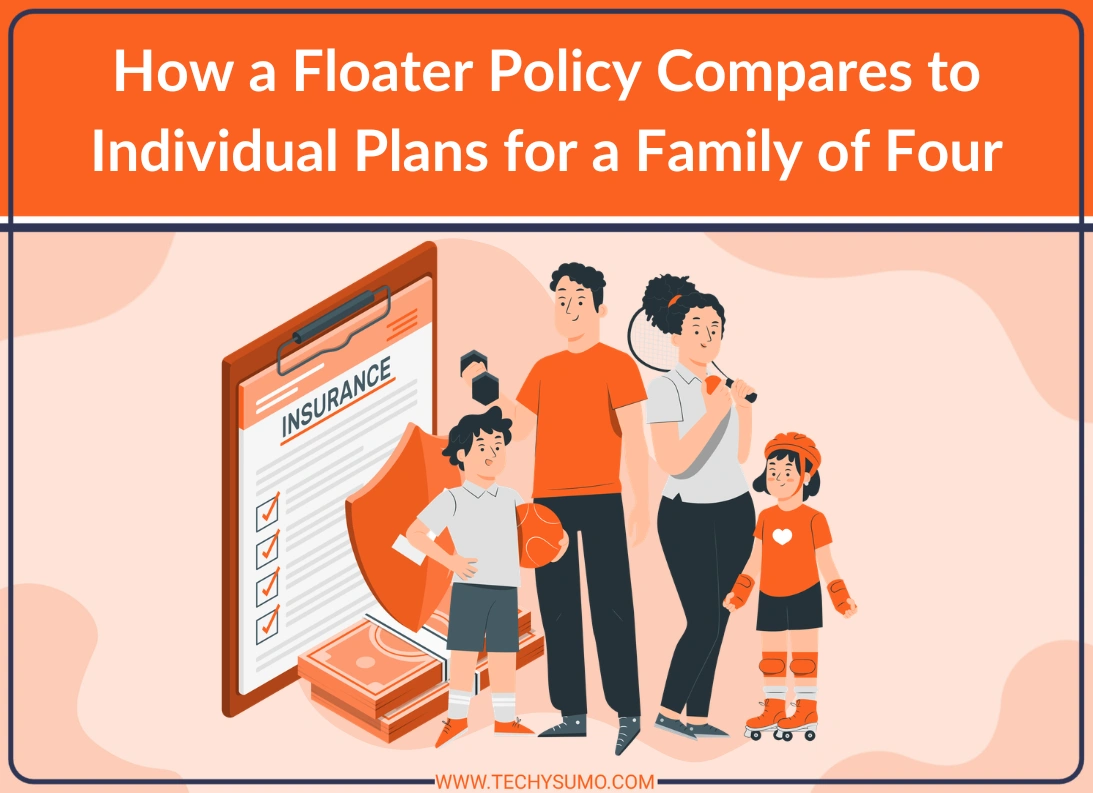
A family of four usually needs health cover that can handle planned care, sudden hospitalisation, and rising medical expenses without making the policy difficult to manage. The choice often comes down to a family floater policy or separate individual health insurance plans.
Both can work well, but the better fit depends on age, health profile, claim pattern, and how the family wants to use the insured amount.
In this article, you will explore how both options differ across coverage, premiums, claims, flexibility, and family suitability.
Table of Contents
What Is a Floater Policy?

A floater policy, also known as a family floater health insurance plan, covers multiple family members under a single shared sum insured. For a family of four, this usually means two adults and two children are covered through a single policy.
Key points include:
Also Read


- One common sum insured is available to all covered members.
- The premium is usually based on the age and health profile of insured members.
- It can be easier to manage than multiple separate policies.
- It may suit younger families with limited claim history.
What Are Individual Health Insurance Plans?
Individual health insurance plans give each family member a separate sum insured. Instead of a single shared policy limit, each person has their own coverage amount, premium, and claim eligibility.
Key points include:
- Every insured member gets an independent policy limit.
- Claims made by one person do not reduce another person’s cover.
- The premium is calculated separately for each member.
- It may suit families with senior members or members with different medical needs.
Key Differences between Floater and Individual Plans
The real difference is not only in policy format. It is in how the cover is used when more than one family member needs care.
Coverage Structure
A floater policy keeps the sum insured common for all members, while individual plans assign a separate insured amount to each person. For a family of four, this difference matters most during repeated hospitalisation or when two members need treatment close together.
Premium Cost
A floater policy may be more cost-effective for younger families, as a single shared cover is issued for all members. Individual plans may lead to a higher combined premium, but each person receives a dedicated policy limit that remains separate.
Flexibility and Customisation
Individual plans may allow more member-specific choices, such as different covers, add-ons, or insured amounts. A floater policy is simpler, but it may not offer the same level of personalisation for each family member’s health profile.
Claim Usage
In a floater plan, one large claim can reduce the available coverage for the rest of the family during the policy year. In individual plans, one person’s claim does not affect the insured amount available to others.
Suitability by Age and Health Condition
A floater policy may suit a young family with similar health needs. Individual plans may be more suitable when parents are older, one member has frequent medical requirements, or the family wants stronger separation of claim limits.
Advantages of a Floater Policy for a Family of Four
A family floater policy can be a sensible option when the family wants broad health insurance coverage without managing several policies. It is often easier to track, renew, and review.
Common advantages include:
- One policy for the whole family.
- Shared cover that any insured member can use.
- Easier renewal and document management.
- Potentially more cost-effective than buying separate plans for everyone.
- Useful for younger families with lower medical usage.
Advantages of Individual Plans for a Family of Four
Individual health insurance plans offer clearer coverage separation. This can be useful when different members have different health risks or when the family wants each person to have their own protected cover.
Common advantages include:
- Separate sum insured for each family member.
- One member’s claim does not reduce another member’s cover.
- Better fit for varied age groups and medical histories.
- More room for member-wise customisation.
- Useful when claim frequency may be higher.
Conclusion
A floater policy and individual plans both have a clear place in health insurance policies for family planning. For a young family of four, a floater policy may offer simplicity and cost efficiency. For families with varied ages, health needs, or higher expected claim usage, individual plans may offer stronger separation. The right choice should be based on health history, budget, policy terms, and long-term coverage needs.