Digital business-to-business (B2B) commerce is fundamentally different from standard consumer retail. While business-to-consumer (B2C) transactions rely almost exclusively on immediate payment processing via credit cards or digital wallets, enterprise procurement operates under a vastly different set of financial rules. Enterprise buying involves negotiated commercial terms, customized credit lines (such as Net-30, Net-60, or Net-90 days), split payment arrangements, and intricate multi-party reconciliation.
When scaling a multi-vendor digital ecosystem, managing the flow of capital between hundreds of corporate buyers and diverse third-party suppliers creates severe operational bottlenecks if handled through manual processes. To solve this, enterprise brands utilize dedicated B2B marketplace development services to build scalable digital platforms equipped with automated financial workflows.
By embedding automated financial management tools directly into the commerce architecture, organizations eliminate administrative overhead, improve cash flow visibility, and cultivate stronger relationships across their vendor networks. Below is a detailed analysis of how modern enterprise marketplaces resolve core financial friction.
Table of Contents
1. Automated Trade Credit and Instant Risk Scoring
In traditional B2B trade, buyers rarely pay upfront. Corporate buyers expect flexible trade credit lines tailored to their transaction history, corporate standing, and pre-negotiated commercial agreements. Historically, issuing trade credit required manual credit checks, physical paperwork, and lengthy reviews by internal finance teams, a process that often delayed sales cycles by days or even weeks.
Modern multi-vendor platforms overcome this delay by integrating automated credit scoring engines directly into the buyer onboarding journey.
Also Read

Key Automated Credit Capabilities:
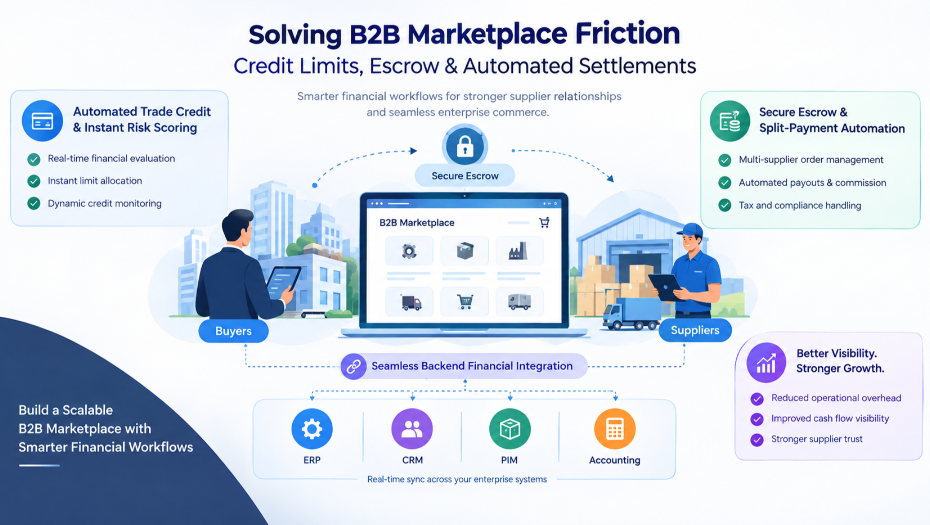
- Real-Time Financial Evaluation: Upon account creation or corporate registration, integrated financial APIs evaluate a buyer’s creditworthiness instantly by analyzing institutional credit databases, past trade references, and data managed through Zoho implementation service integrations.
- Instant Limit Allocation: Qualified corporate accounts receive pre-approved credit limits immediately, allowing procurement teams to start placing orders without administrative delays.
- Dynamic Credit Monitoring: The platform tracks credit utilization in real time across all active orders. If a buyer reaches or exceeds their allocated credit cap, the system automatically restricts new purchase orders or prompts the account holder to settle outstanding balances before proceeding.
By digitizing credit management, marketplace operators can offer the flexible terms enterprise buyers expect while protecting platform owners from unmanaged financial risk.
2. Secure Escrow and Split-Payment Automation
Multi-vendor transactions frequently involve complex purchase orders containing products or services from multiple distinct suppliers within a single checkout session. Manually processing these multi-supplier orders, splitting invoices, calculating variable vendor commissions, managing shipping holds, and disbursing final payments, creates an administrative nightmare that is highly susceptible to human error.
Automated escrow workflows and smart payment splitters solve this operational challenge by securing funds upon order placement and automating disbursements based on predefined fulfillment triggers. These workflows can also be streamlined through Zoho implementation service integrations to improve the coordination of customer, payment, and transaction data across connected business systems.
When an order is submitted, funds are allocated securely into escrow or reserved against the buyer’s trade credit line. Once shipping verification, tracking updates, or digital proof-of-delivery (POD) receipts are registered in the system, the platform automatically triggers the payout sequence:
- Supplier Disbursements: Individual vendor earnings are transferred directly into supplier bank accounts according to agreed-upon payment schedules.
- Automated Commission Deduction: Marketplace platform fees, transaction charges, and vendor commission percentages are calculated and retained automatically.
- Tax and Compliance Splitting: Regional sales taxes, value-added taxes (VAT), and cross-border duties are split and logged accurately for financial reporting and auditing.
3. Seamless Backend Financial Integration
A persistent operational risk in digital commerce is the creation of data silos between the front-end sales portal and back-office financial ledgers. When transactional data fails to synchronize instantly across systems, organizations face inventory misalignments, payment reconciliation errors, and inaccurate financial reporting.
To maintain absolute data integrity, front-end marketplace workflows must sync continuously with backend accounting systems, Customer Relationship Management zoho CRM portals, Product Information Management (PIM) tools, and Enterprise Resource Planning (ERP) software like SAP, Microsoft Dynamics, ERPNext, or Odoo.
When implementing these complex multi-supplier architectures, global brands often collaborate with an experienced Digital Commerce Partner to engineer high-performance digital infrastructure, custom PIM/ERP synchronizations, and scalable growth strategies.
Continuous backend integration ensures that every order placement, credit adjustment, vendor payout, and invoice generation reflects immediately across all financial records. This real-time synchronization gives financial controllers complete visibility into working capital, pending liabilities, and marketplace profit margins.
Conclusion
Overcoming financial friction is essential for building a sustainable, high-volume multi-vendor ecosystem. By digitizing trade credit allocation, automating escrow disbursements, and maintaining continuous synchronization with core enterprise systems, modern platforms reduce operational overhead, strengthen supplier trust, and deliver the flexible financial capabilities modern enterprise buyers require.
Author Bio
Ronak Meghani
Ronak Meghani is the CEO & Co-Founder of Magneto IT Solutions, where he partners with medium and enterprise brands to design, build, and scale next-generation digital commerce ecosystems. With experience across 200+ B2B, D2C, and B2C engagements, he specializes in creating customer-centric, AI-enabled, and conversion-driven commerce experiences.
Ronak works closely with organizations to move beyond traditional eCommerce by aligning strategy, technology, and customer experience. He focuses on transforming commerce platforms into continuously evolving, revenue-generating engines through AI-driven optimization and scalable growth strategies.