The golden rule of pregnancy skincare is this: no brand is universally “safe” or “unsafe.” Safety is determined solely by the specific formulation of an individual product.
Nivea, Burt’s Bees, and Mustela are all reputable brands that offer pregnancy-safe options. However, they also manufacture products that contain ingredients dermatologists and obstetricians strongly advise against during gestation.
Here is your comprehensive, science-backed guide to navigating these three brands while expecting.
Table of Contents
- 1. The “Red Flag” Ingredients to Avoid
- 2. Brand-by-Brand Safety Analysis
- 3. The Ultimate Comparison Table
- 4. Your 5-Step Action Plan for Shopping These Brands
- Q1: As a pregnant woman, is one of these brands (Nivea, Burt’s Bees, Mustela) automatically “safer” than the others?
- Q2: What are the absolute “red flag” ingredients I must avoid in any of these brands?
- Q3: Is Nivea safe to use during pregnancy?
- Q4: Is Burt’s Bees safe during pregnancy? Isn’t it “natural”?
- Q5: Is Mustela the safest of the three?
- Q6: Can you give me a quick side-by-side comparison?
- Q7: What is my practical action plan for buying from these brands?
- Q8: So, which brand should I ultimately choose?
- Q9: How can I get an even more personalized recommendation?
1. The “Red Flag” Ingredients to Avoid
Before comparing brands, you must know what to look for on the back of the bottle. During pregnancy, hormonal shifts increase skin sensitivity and absorption. Medical professionals universally recommend avoiding the following:
- Retinoids (Vitamin A derivatives): This includes Retinol, Retinyl Palmitate, Retinaldehyde, and Tretinoin. Oral retinoids are teratogenic (cause birth defects). While topical absorption is minimal, the medical consensus is to err on the side of extreme caution and avoid them entirely during pregnancy and breastfeeding.
- Hydroquinone: A potent skin-lightening agent used for melasma (dark spots). It has a high skin-absorption rate, leading most dermatologists to ban its use during pregnancy.
- High-Dose Salicylic Acid: While low-dose salicylic acid (under 2%) in face washes is generally considered safe, high-concentration chemical exfoliants or peels should be avoided.
- Certain Chemical UV Filters: Ingredients like Oxybenzone and Avobenzone are endocrine disruptors in animal studies. Although human data is inconclusive, physical (mineral) blockers are strongly preferred during pregnancy.
- Certain Preservatives: Some studies suggest avoiding Parabens (like Methylparaben, Propylparaben) and Phthalates due to their potential hormonal interference.
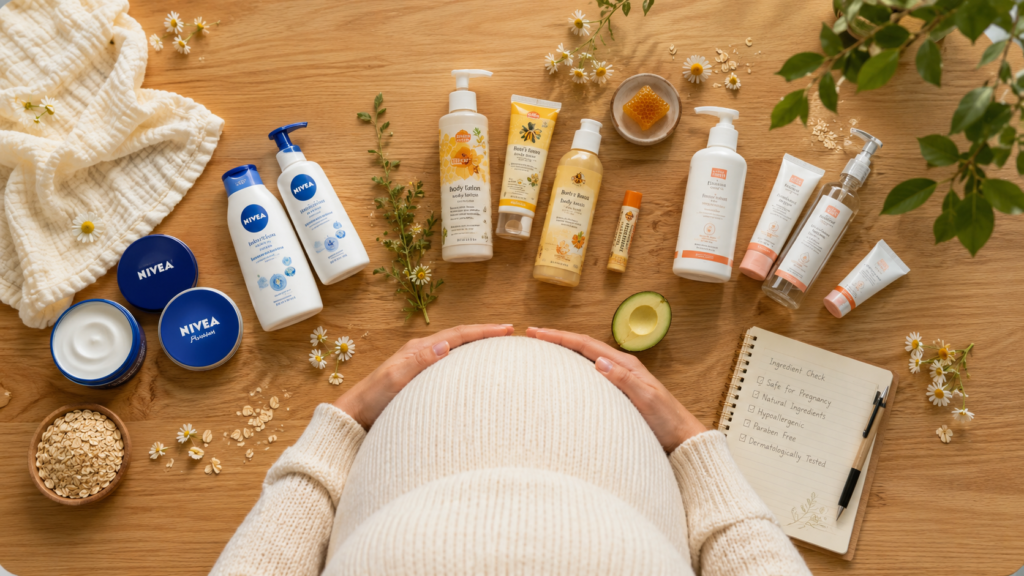
2. Brand-by-Brand Safety Analysis
Here is how the “Big Three” stack up against each other when you are pregnant.
Also Read
A. Nivea (The Mass-Market Giant)
The Vibe: Accessible, affordable, and available everywhere. However, Nivea’s portfolio is massive, ranging from heavy moisturizers (in the iconic blue tins) to aggressive anti-aging serums.
- What is Safe: Nivea’s basic, fragrance-controlled moisturizers, gentle foaming cleansers, and mineral-based sunscreens are excellent and safe choices. Notably, Nivea has begun incorporating Bakuchiol (a plant-based, pregnancy-safe alternative to Retinol) into some of its new anti-aging lines, which is a fantastic option for expectant mothers wanting anti-aging benefits without the risk.
- What to Avoid: You must avoid Nivea products that list Retinol or any of its derivatives in the first half of the ingredients list. Also, steer clear of their “Cellulite” or “Firming” creams that contain high concentrations of caffeine or synthetic fragrances if you are prone to nausea or skin irritation.
- The Verdict: Nivea requires the most “ingredient detective work.” You can use it safely, but you cannot buy blindly.
B. Burt’s Bees
The Vibe: Nature-derived, heavily reliant on botanical oils, beeswax, and plant extracts.
- What is Safe: Burt’s Bees has a dedicated “Mama Bee” maternity line, which is specifically formulated for pregnancy. These products are explicitly free from Phthalates, Parabens, Petrolatum, and SLS (Sodium Lauryl Sulfate). Their Belly Butter and Body Oil are widely regarded as safe for hydrating stretching skin.
- What to Avoid: This is where “natural” can be deceiving. Just because it is plant-based does not mean it is pregnancy-safe. Burt’s Bees uses high concentrations of essential oils (like peppermint, clove, and citrus oils) in many of their mainstream products. Essential oils can cause contact dermatitis (irritation) on highly sensitive pregnant skin, and some (like sage or rosemary oil in high doses) are traditionally cautioned against in the first trimester. Furthermore, some of their facial products contain Salicylic Acid derived from willow bark—check the percentage; if it is over 2%, skip it.
- The Verdict: Stick exclusively to their “Mama Bee” labeled products, and patch-test any heavily scented botanical creams before applying them to your entire belly.
C. Mustela
The Vibe: Mustela was literally invented for maternity and infant skincare. It is a pharmaceutical-grade brand with a heavy focus on hypoallergenic formulations.
- What is Safe: Mustela is arguably the most “plug-and-play” safe option of the three. Their entire “Maternity” line (Stretch Marks Prevention Cream, Bust Firming Serum, and Soothing Moisturizing Cream) is formulated without Retinoids, Parabens, Phthalates, or artificial dyes. Many of their products have received the EWG Verified seal, meaning they meet the Environmental Working Group’s strictest health standards. They use patented natural ingredients like Avocado Peptides and Galactoarabinan (from larch trees) which are clinically tested for safety on pregnant women.
- What to Avoid: While their maternity range is gold-standard, Mustela also produces a “Baby” line and a “Hair Care” line. Some of their hair care products contain AHA/BHA blends for scalp exfoliation. While safe in tiny amounts, you might want to avoid these if you are overly cautious.
- The Verdict: If you want peace of mind with zero guesswork, Mustela’s maternity-specific products are the safest bet out of the three brands.
3. The Ultimate Comparison Table
| Feature | Nivea | Burt’s Bees | Mustela |
|---|---|---|---|
| Dedicated Pregnancy Line | No (mixed portfolio) | Yes (Mama Bee) | Yes (Maternity Range) |
| Paraben/Phthalate Free | Only specific lines | Yes (Mama Bee line) | Yes (All maternity lines) |
| Retinol-Free Guarantee | No (check labels) | Yes (Mama Bee) | Yes (Maternity line) |
| Risk Factor | High (must read labels thoroughly) | Moderate (avoid essential oil-heavy products) | Low (clinically tested for gestation) |
| Best For | Basic body moisturizers and physical sunscreens | Natural belly butters and oils | All-round daily face/body regimen with zero worry |
4. Your 5-Step Action Plan for Shopping These Brands
- Become a Label Reader: Download a reliable app like Yuka or Think Dirty to scan barcodes quickly, but always cross-check with the INCI (International Nomenclature of Cosmetic Ingredients) list for the red-flag ingredients mentioned above.
- Simplify Your Routine: Pregnancy is not the time to experiment with 10-step routines. Stick to a gentle cleanser, a heavy-duty moisturizer, and mineral SPF.
- Prioritize Mineral SPF: If you buy sunscreen from any of these brands, ensure the active ingredients are Zinc Oxide or Titanium Dioxide. These sit on top of the skin rather than being absorbed into the bloodstream.
- Patch Test Everything: Pregnancy changes your immune system. A product you used for years might suddenly cause a rash. Apply a small amount to your inner arm and wait 24 hours before using it on your belly or face.
- Consult Your OB/Midwife: When in doubt, take a picture of the ingredient list to your next prenatal appointment. Your doctor can quickly greenlight or redlight it based on your specific medical history.
The Final Verdict:
- Choose Mustela if you want a medically-oriented, research-backed line designed specifically for pregnancy, and you are willing to pay a premium for that security.
- Choose Burt’s Bees (specifically the Mama Bee line) if you prefer plant-based, natural ingredients and want a highly effective, thick moisturizer for a stretching belly.
- Choose Nivea only if you are on a budget and are willing to meticulously inspect ingredient lists—selecting only their basic, fragrance-free, retinol-free moisturizers and avoiding their complex anti-aging serums.
To help me give you an even more targeted recommendation, could you please share:
- Which specific product are you currently considering from these brands (e.g., Nivea Soft Creme, Burt’s Bees Mama Bee Belly Butter, Mustela Stretch Marks Oil)?
- What is your primary skincare goal right now (e.g., preventing stretch marks, managing acne breakouts, basic hydration, or fighting dark spots)?
- Are you in your first, second, or third trimester? (This changes sensitivity levels and acceptable ingredients).
Q1: As a pregnant woman, is one of these brands (Nivea, Burt’s Bees, Mustela) automatically “safer” than the others?
A: No. No brand is universally “safe” or “unsafe” during pregnancy. Safety depends entirely on the specific product’s ingredient list, not the name on the box.
All three brands manufacture products that are perfectly safe for pregnancy, and all three manufacture products that contain ingredients dermatologists advise against during gestation. The key is knowing what to look for on the label, rather than trusting a brand name blindly.
Q2: What are the absolute “red flag” ingredients I must avoid in any of these brands?
A: Regardless of whether you pick Nivea, Burt’s Bees, or Mustela, scan the ingredient list for these core offenders:
- Retinoids (Vitamin A derivatives): Includes Retinol, Retinyl Palmitate, Retinaldehyde, and Tretinoin. Oral forms are linked to birth defects, and while topical absorption is low, medical consensus is to avoid them entirely as a precaution.
- Hydroquinone: A powerful skin-lightening agent used for dark spots (melasma). It has a high absorption rate and is strongly discouraged during pregnancy.
- High-concentration Salicylic Acid: Under 2% in a wash-off cleanser is usually fine, but leave-on serums or peels with higher concentrations should be avoided.
- Certain Chemical Sunscreens: Ingredients like Oxybenzone and Avobenzone are potential endocrine disruptors. Mineral blockers (Zinc Oxide/Titanium Dioxide) are heavily preferred.
- Parabens & Phthalates: These preservatives and plasticizers are flagged for potential hormonal interference, so many pregnancy-safe lines exclude them.
Q3: Is Nivea safe to use during pregnancy?
A: Yes, but only if you are very selective. Nivea has a massive product range, which makes it the riskiest of the three if you buy impulsively.
- Safe choices: Their basic, fragrance-controlled moisturizers (like the plain Nivea Creme in the blue tin, in moderation), gentle cleansers, and mineral-based sunscreens are excellent. Nivea also uses Bakuchiol (a plant-based, pregnancy-safe alternative to Retinol) in some new anti-aging lines – this is a great option if you want anti-aging benefits safely.
- Avoid: Any Nivea product listing Retinol or derivatives in the top half of the ingredients. Also skip their “Cellulite” or “Firming” creams with high caffeine or synthetic fragrance blends, as these can irritate sensitive pregnant skin.
- Verdict: Nivea requires the most “ingredient detective work.” Read every label carefully.
Q4: Is Burt’s Bees safe during pregnancy? Isn’t it “natural”?
A: Yes and no. The “natural” label is deceptive during pregnancy.
- Safe choices: Stick exclusively to their dedicated “Mama Bee” maternity line. This range is specifically formulated for pregnancy and is free from Phthalates, Parabens, Petrolatum, and SLS. Their Belly Butter and Body Oil are widely used and trusted for stretching skin.
- Avoid: Burt’s Bees uses high concentrations of essential oils (peppermint, clove, rosemary, citrus) in many of their mainstream body washes and lotions. Essential oils can cause severe contact dermatitis (rashes) on highly sensitive pregnant skin. Furthermore, some facial products contain Salicylic acid derived from willow bark – check the percentage; if it’s over 2%, skip it.
- Verdict: Buy their “Mama Bee” labeled products, and always patch-test any heavily scented botanical cream before applying it to your full belly.
Q5: Is Mustela the safest of the three?
A: Yes, arguably. Mustela is the most “plug-and-play” safe option because the brand was literally invented for maternity and infant skincare.
- Safe choices: Their entire “Maternity” range (Stretch Marks Cream, Bust Firming Serum, Soothing Moisturizer) is clinically formulated without Retinoids, Parabens, Phthalates, or artificial dyes. Many products carry the EWG Verified seal (Environmental Working Group), meaning they meet strictest health standards. They use patented ingredients like Avocado Peptides clinically tested on pregnant women.
- Avoid: While their maternity range is gold-standard, Mustela also makes “Baby” products and “Hair Care” lines. Some hair products contain AHA/BHA blends for scalp exfoliation – safe in tiny amounts, but you might skip them if overly cautious.
- Verdict: If you want peace of mind with zero guesswork and are willing to pay a premium, Mustela’s maternity-specific products are the safest bet.
Q6: Can you give me a quick side-by-side comparison?
A: Absolutely. Here is how they stack up:
| Feature | Nivea | Burt’s Bees | Mustela |
|---|---|---|---|
| Dedicated Pregnancy Line? | No (mixed portfolio) | Yes (Mama Bee) | Yes (Maternity Range) |
| Paraben/Phthalate Free? | Only specific lines | Yes (Mama Bee) | Yes (All maternity lines) |
| Retinol-Free Guarantee? | No (must check labels) | Yes (Mama Bee) | Yes (Maternity line) |
| Risk Level | High – requires careful label reading | Moderate – avoid essential-oil products | Low – clinically tested for gestation |
| Best For | Basic moisturizers & physical sunscreens | Natural belly butters and oils | Daily face/body regimen with zero worry |
Q7: What is my practical action plan for buying from these brands?
A: Follow these 5 steps every time you shop:
- Read the INCI list: Don’t just read the front marketing claims. Flip the bottle and scan the full ingredient list for the red-flag ingredients listed in Q2.
- Use a scanning app: Apps like Yuka or Think Dirty can help you quickly scan barcodes, but always cross-check manually for Retinol and Hydroquinone.
- Simplify your routine: Pregnancy is not the time for 10-step routines. Stick to a gentle cleanser, a heavy moisturizer, and a mineral SPF (Zinc Oxide or Titanium Dioxide).
- Patch test everything: Pregnancy changes your immune system. Apply a small amount to your inner arm and wait 24 hours before using it on your belly or face.
- Show your OB: When in doubt, take a photo of the ingredient list to your prenatal appointment and ask your doctor to greenlight it.
Q8: So, which brand should I ultimately choose?
A: It depends on your personal preference and budget:
- Choose Mustela if you want a medically-oriented, research-backed line designed specifically for pregnancy, and you value maximum security over cost.
- Choose Burt’s Bees (Mama Bee) if you prefer plant-based, natural ingredients and want a thick, highly effective moisturizer for a stretching belly.
- Choose Nivea only if you are on a budget and are willing to meticulously inspect ingredient lists – selecting only their basic, fragrance-free, retinol-free moisturizers while avoiding their complex anti-aging serums.
Q9: How can I get an even more personalized recommendation?
A: To help me narrow down the specific product for your unique situation, please share:
- Which specific product are you currently considering from these brands (e.g., Nivea Soft Creme, Burt’s Bees Mama Bee Belly Butter, Mustela Stretch Marks Oil)?
- What is your primary skincare goal right now (e.g., preventing stretch marks, managing acne breakouts, basic hydration, or fighting dark spots)?
- Are you in your first, second, or third trimester? (This changes skin sensitivity levels and which ingredients are most tolerable.)