
Most serious investors reach a point where the conventional mutual fund universe begins to feel insufficient, not because it has failed them, but because they have outgrown the constraints it imposes. Their equity funds are competent but entirely correlated with market direction. Their debt funds are stable but tactically limited. The portfolio performs. It just cannot do everything they need it to do.
This is precisely the gap that a Specialised Investment Fund (SIF) is designed to fill. Introduced by SEBI effective April 1, 2025, the SIF is not a replacement for conventional mutual funds. It is a complement: a regulated instrument that extends the portfolio’s capability into strategies the standard mutual fund framework does not permit.
Let’s understand where an SIF fits within an existing mutual fund portfolio and how to deploy it with precision.
Table of Contents
What an SIF Adds That Mutual Funds Cannot
An SIF adds strategic flexibility to an existing mutual fund portfolio, especially through long-short strategies and derivative-based positioning.
Most conventional equity mutual funds are largely long-only in their core portfolio construction. While they may use derivatives within regulatory limits, downside management usually depends on stock selection, sector rotation, cash positioning, and limited hedging.
Also Read


An SIF fund can take unhedged short positions of up to 25% of the portfolio through derivative instruments. This may help the strategy seek returns from declining securities or reduce downside impact when short positions work effectively. For investors whose mutual fund portfolio is highly linked to broad market direction, a long-short SIF can add a differentiated return stream and potentially improve risk-adjusted outcomes.
The Four Portfolio Roles an SIF Can Play
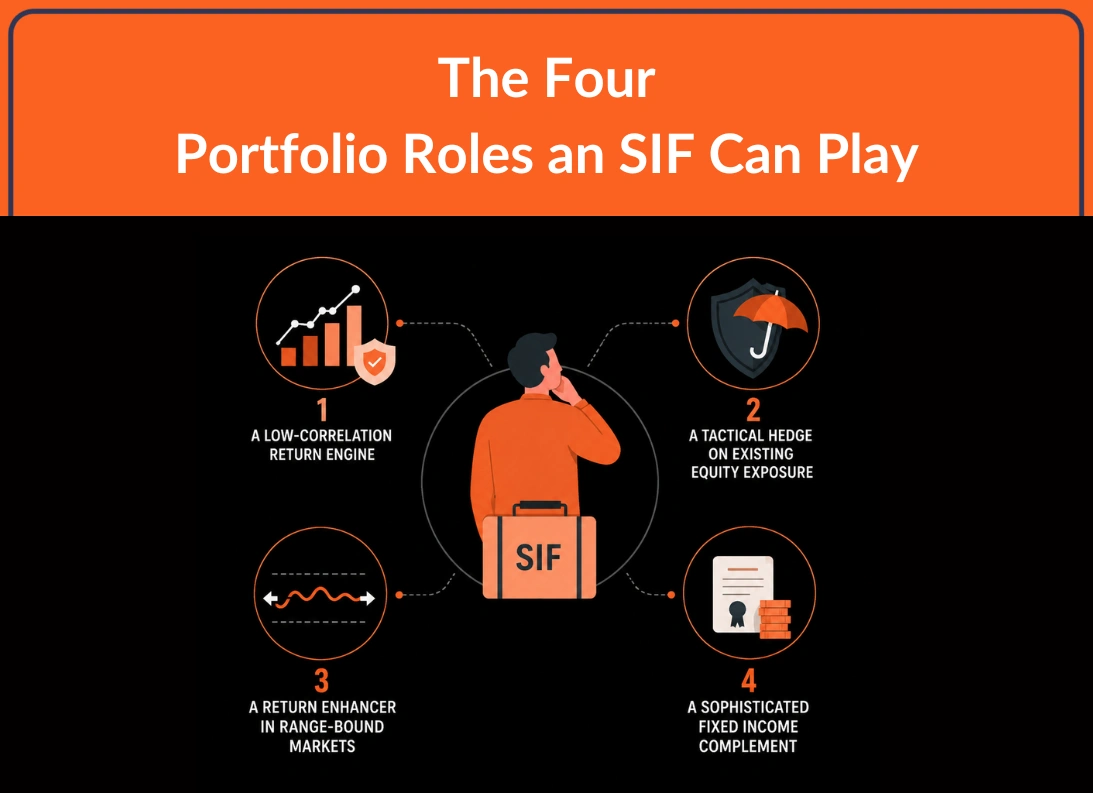
An SIF can serve four distinct functions within a mutual fund portfolio, each addressing a structural limitation that long-only funds cannot resolve on their own.
A Low-correlation Return Engine
A long-short SIF strategy is designed to generate returns that are less correlated with the broader equity market than any conventional mutual fund can achieve. For an investor whose portfolio is already well-diversified across large, mid, and small cap funds, adding an SIF with a market-neutral or low-net-exposure mandate introduces a genuinely different return stream.
This is the most distinctive role an SIF plays: not simply diversification across securities, but diversification across strategy types.
A Tactical Hedge on Existing Equity Exposure
Investors with significant equity mutual fund holdings face a structural vulnerability: in sharp market corrections, all their equity positions decline simultaneously, regardless of how diversified their fund selection is.
An SIF with meaningful short exposure to overvalued large cap stocks or vulnerable sectors can act as a partial offset to this correlated drawdown. This cushions the overall portfolio’s peak-to-trough decline without requiring the investor to reduce their core equity allocations.
A Return Enhancer in Range-bound Markets
Indian equity markets periodically enter extended phases of sideways consolidation. These are periods where the index delivers negligible returns over 12–18 months while individual stocks and sectors diverge significantly. These environments are where long-only mutual funds struggle to generate meaningful alpha, because the market’s aggregate direction offers limited tailwind.
A well-managed SIF can exploit this divergence directly, going long on stocks expected to outperform and short on those expected to underperform. This is generating positive returns in an environment where conventional funds are treading water.
A Sophisticated Fixed Income Complement
Not all SIF strategies are equity-focused. SEBI’s framework permits debt-oriented SIF strategies with greater flexibility than conventional debt mutual funds. This enables active positioning across the yield curve, credit spectrum, and duration profile in ways that standard debt fund categories do not permit.
For investors who are dissatisfied with the constrained return potential of conventional debt funds but are not ready to move into unlisted credit or AIF structures, a debt-oriented SIF can offer a meaningful middle ground.
How Much of the Portfolio Should Go Into an SIF?
The SIF is not designed to be a core holding. It is a satellite instrument, one that amplifies the portfolio’s capability without displacing its foundation. For most investors, an allocation of 10–20% of the total investable portfolio to an SIF strategy is a sensible starting point, with the specific sizing determined by the investor’s risk tolerance, the strategy’s expected volatility, and the degree of correlation reduction being sought.
The minimum investment threshold of ₹10 lakh per investor aggregated at the PAN level across all strategies within a single AMC. An SIF is better positioned as a satellite allocation rather than a core holding. The allocation should depend on the investor’s risk profile, liquidity needs, investment horizon, existing equity exposure, and advice from a qualified financial professional.
What to Evaluate Before Adding an SIF
Adding an SIF to an existing mutual fund portfolio is not a decision to be made on the basis of a compelling brochure or recent performance. The evaluation framework should examine three things specifically.
- The first is strategy clarity. An SIF strategy document should articulate precisely what it does, what it goes long on, what it goes short on, and under what conditions. Vague or overly broad strategy mandates are a warning sign.
- The second is the AMC’s track record in managing complexity. The SIF framework requires SEBI-eligible AMCs with demonstrated capability, but eligibility is not the same as excellence. Review the AMC’s history of managing derivative-enabled strategies, if any, before committing capital.
- The third is liquidity terms. Some SIF strategies operate on interval or notice-based redemption frameworks. Investors must ensure their personal liquidity requirements are compatible with the fund’s specific redemption structure before investing.
The SIF as the Portfolio’s Next Frontier
A thoughtfully constructed mutual fund portfolio is a strong foundation. An SIF allocation builds on that foundation, adding the strategic dimensions of short exposure, derivative-driven return generation, and low-correlation strategies that conventional funds simply cannot provide.
The result is a portfolio that is not simply diversified across securities and market caps but also across investment strategies, and it is capable of generating returns across a wider range of market environments.
Online investment platforms like Jio BlackRock make it possible to evaluate SIF fund strategies with the transparency and analytical rigour that this decision demands. The mutual fund portfolio you have built is not the ceiling. It is the starting point.