Ten years ago, data science was the cutting edge of tech. Today, artificial intelligence has taken the lead; machines no longer just analyze data, they learn from it.
If you’re choosing a path in this space, the question is simple: do you want to interpret intelligence or create it?
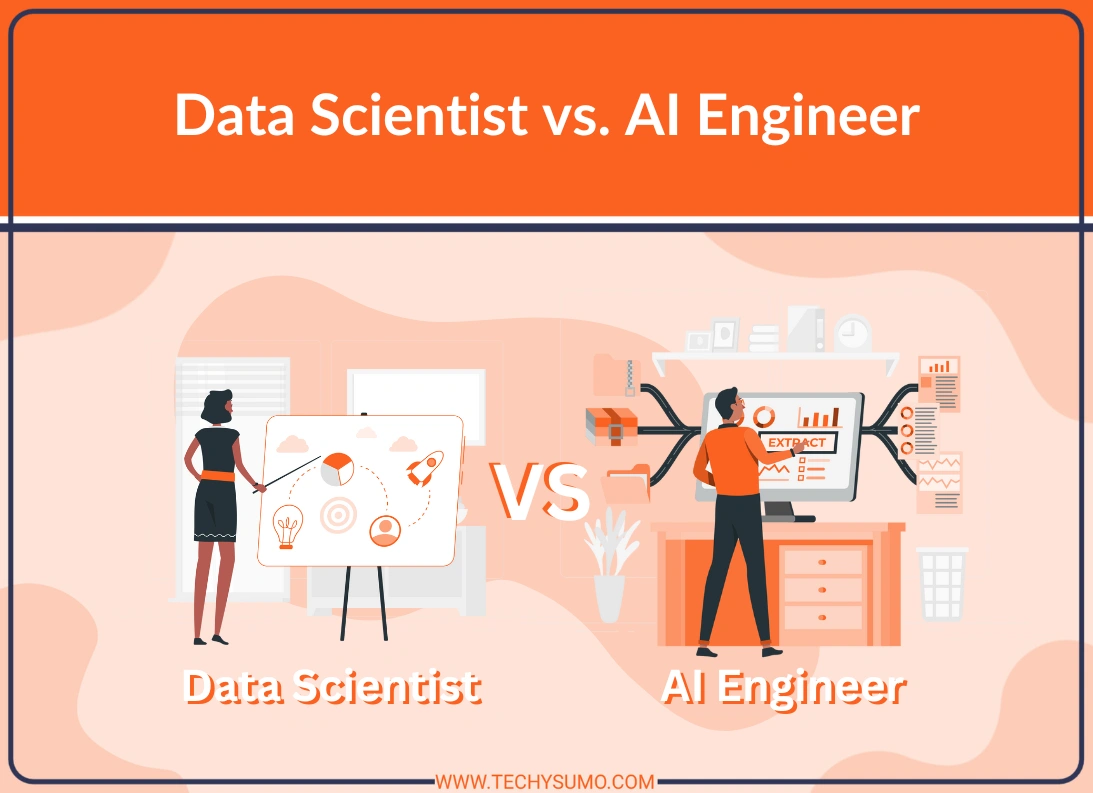
Data scientists find meaning in information. AI engineers turn that meaning into systems that think and act on their own.
Both careers are shaping the future, but they do it in very different ways.
This article looks at how these two careers compare in terms of skills, responsibilities, education, and long-term opportunities, to help you decide which one might be a better fit for you.
Table of Contents
Also Read


The Rise of Data and Intelligence
Over the past decade, the way we use data has changed drastically. What began as simple reporting and dashboards has evolved into systems that can predict, recommend, and even act without human input. Data is no longer just a record of what happened; it’s the foundation for creating intelligent behavior in machines.
This shift has given rise to two closely connected fields: data science and artificial intelligence. Data science focuses on understanding information, collecting it, cleaning it, and finding patterns that reveal how things work or what might happen next. Artificial intelligence takes those insights further, using them to build algorithms and models that can make decisions or perform tasks on their own.
If you look at the numbers, they paint a clear picture. The global data science market is projected to exceed $178 billion by 2025, while AI is expected to reach more than $200 billion by 2026. These aren’t just statistics; they reflect a growing reliance on technology that learns, reasons, and adapts.
As companies across every sector, such as finance, healthcare, manufacturing, retail, and education, continue to integrate AI and data-driven systems, the demand for skilled professionals is only increasing. Whether you’re drawn to analyzing patterns or building intelligent solutions, this is one of the most exciting times to enter either field.
The Data Scientist’s World
A data scientist’s work begins long before any model is built. Most of their time goes into understanding the problem, collecting the right data, and shaping it into something reliable. The goal is simple: make sense of information so that decisions are based on evidence rather than guesswork.
In practice, this involves several layers. They explore datasets to see what’s actually happening, look for patterns that aren’t obvious at first glance, and choose the right statistical or machine-learning techniques to test their ideas. Tools like Python, SQL, R, Spark, or even basic spreadsheets are part of the process, depending on the size and complexity of the data.
What makes the role interesting is that it sits at the intersection of analysis and storytelling. A data scientist doesn’t just run models; they also translate the results into something the rest of the organization can use, whether that’s predicting customer churn, identifying operational inefficiencies, or estimating the impact of a new product feature.
The work can be deeply technical, but it’s ultimately about clarity. Good data scientists help teams see what the data is saying, why it matters, and what might happen next.
The AI Engineer’s World
If a data scientist’s job is to understand what the data is saying, an AI engineer’s job is to make something that acts on it. They build systems that can learn, adapt, and make decisions, often without direct human guidance.
AI engineers work on a wide range of problems. Some develop models that recognize objects in images or translate languages in real time. Others design recommendation engines, chatbots, or predictive systems that run quietly in the background of everyday apps.
Their work combines programming, mathematics, and software design. And so, a solid grasp of machine learning, deep learning, and neural networks is essential. They also rely heavily on languages like Python, C++, or Java, and frameworks such as TensorFlow, PyTorch, and Keras. Beyond algorithms, they focus on deployment, making sure the models run efficiently in production, integrate with other systems, and scale as data grows.
An AI engineer bridges theory and application. They take the insights uncovered by data scientists and turn them into intelligent systems that can automate tasks or create new experiences. In many ways, they’re the builders of digital intelligence, transforming abstract ideas into real, working technology.
Where the Two Roles Meet
While data scientists and AI engineers focus on different parts of the process, their work often overlaps. Both rely on data, statistics, and machine learning, and both are driven by the same goal: using information to make systems smarter.
In many organizations, the two roles collaborate closely. A data scientist might develop a predictive model, and an AI engineer would take that model and turn it into a production-ready system. In smaller teams or startups, the same person may even do both.
Because the boundaries are fluid, people often move between these roles as their skills grow. Understanding how they connect makes it easier to decide where to start and what to learn first.
| Aspect | Data Scientist | AI Engineer |
| Core Focus | Extract insights and patterns from data | Build systems that can learn and act on data |
| Primary Goal | Help organizations make data-driven decisions | Create intelligent products and automation |
| Key Skills | Statistics, data wrangling, visualization, ML | Deep learning, neural networks, model deployment |
| Common Tools | Python, R, SQL, Tableau, Spark | Python, TensorFlow, PyTorch, C++, APIs |
| Typical Output | Reports, dashboards, predictive models | AI-driven applications, APIs, or automation systems |
| Work Style | Analytical, exploratory, interpretive | Engineering-oriented, experimental, systems-focused |
Education and Skill Pathways
Both data science and AI engineering require a strong base in mathematics, statistics, and computer science. The difference lies in how each field applies these skills.
Data scientists often come from backgrounds in statistics, economics, or computer science. A degree that builds analytical thinking and involves plenty of hands-on work with data is ideal. Many learners today strengthen their foundations through industry-aligned programs like Intellipaat’s Data Science course, which combines Python, R, SQL, and machine learning with real-world projects guided by experts.
AI engineers, on the other hand, usually follow a more technical route. Degrees in computer science, electrical engineering, or related fields are common. Understanding algorithms, deep learning, and model deployment is crucial. Programs such as Intellipaat’s AI and Machine Learning Certifications, developed with top universities and industry partners, help bridge that gap, offering practical exposure to tools like TensorFlow, PyTorch, and NLP systems.
While postgraduate degrees can open doors, they’re not always mandatory. What truly stands out today is your ability to apply concepts, to build models, experiment with data, and turn theory into solutions. Employers often value a strong portfolio over a long list of credentials.
If you’re just starting out, focus on learning by doing. Compete on Kaggle, publish projects on GitHub, or replicate real-world business use cases. These experiences, combined with a structured learning path, can give you the confidence and credibility to start strong in either field.
Data Scientist Salary Trends
In India, a career as a data scientist starts at a solid level and offers strong growth as you gain experience. For example:
- The average salary for a data scientist is around ₹17 lakh per annum in India.
- Earlier-career (1–4 years) data scientists may earn ₹8-10 lakh per annum, while mid-level (4-9 years) are typically in the ₹12-15 lakh range.
- Some senior data scientists or those in niche/leadership roles can earn up to ₹25 lakh or more in India.
AI Engineer Salary Trends
The role of an AI engineer is slightly more specialised, and in many markets, that reflects in the salary.
- In India, entry-level AI engineers can begin at around ₹6 lakh per annum, while mid-level roles may be in the ₹17 lakh per annum range.
- For experienced engineers (especially in product firms or with generative/LLM/AI specialisation), salaries can go up to ₹30‐50 lakh or more.
Closing Thoughts
Whether you choose data science or AI engineering, both paths lead toward the future of technology. The difference lies less in the destination and more in the kind of problems you want to solve. Data scientists turn raw information into insights that guide decisions. AI engineers build the systems that make those decisions automatically at scale.
As industries continue to rely on intelligent systems, these roles will only grow in importance. What matters most is staying curious, experimenting often, and learning continuously, because the tools may change, but the core skills of logic, creativity, and problem-solving never go out of style.
If you’re ready to begin that journey, structured programs like Intellipaat’s courses can help you gain the hands-on experience employers actually look for, turning your curiosity into a practical, career-ready skill set.
In the end, data and AI aren’t competing fields. They’re two sides of the same revolution, and the smartest move is simply to start.